How to Think
How to Think
— Alan Jacobs
Sharp ideas on social belonging, group identity, intellectual courage, and why genuine thinking is so hard to do alone.
Social Approval & The Inner Ring
One of the book’s most unsettling arguments: the desire to belong to the right group is so powerful that it quietly shuts down thinking altogether. We don’t adopt ideas because they’re true — we adopt them because they signal membership.
“In all men’s lives at certain periods, and in many men’s lives at all periods, one of the most dominant elements is the desire to be inside the local Ring and the terror of being left outside.”
“Why would people ever think, when thinking deprives them of the pleasure of sharing an attitude one knows is socially approved?”
“The more useful a term is for marking my inclusion in a group, the less interested I will be in testing the validity of my use of that term against any kind of standard.”
“Very simply, it is a great example of our collective eagerness to disparage without knowledge or information about the thing disparaged, when the reward is the pleasure of sharing an attitude one knows is socially approved.”
How the Inner Ring Draws You In
“Once we are drawn in, once we’re part of the Inner Ring, we maintain our status in part by coming up with post hoc rationalizations that confirm our group identity and, equally important, confirm the nastiness of those who are Outside, who are Not Us.”
“The Inner Ring discourages, mocks, and ruthlessly excludes those who ask uncomfortable questions.”
“The pressures imposed on us by Inner Rings make genuine thinking almost impossible by making belonging contingent on conformity.”
True Belonging vs False Belonging
“The only real remedy for the dangers of false belonging is the true belonging to, true membership in, a fellowship of people who are not so much like-minded as like-hearted.”
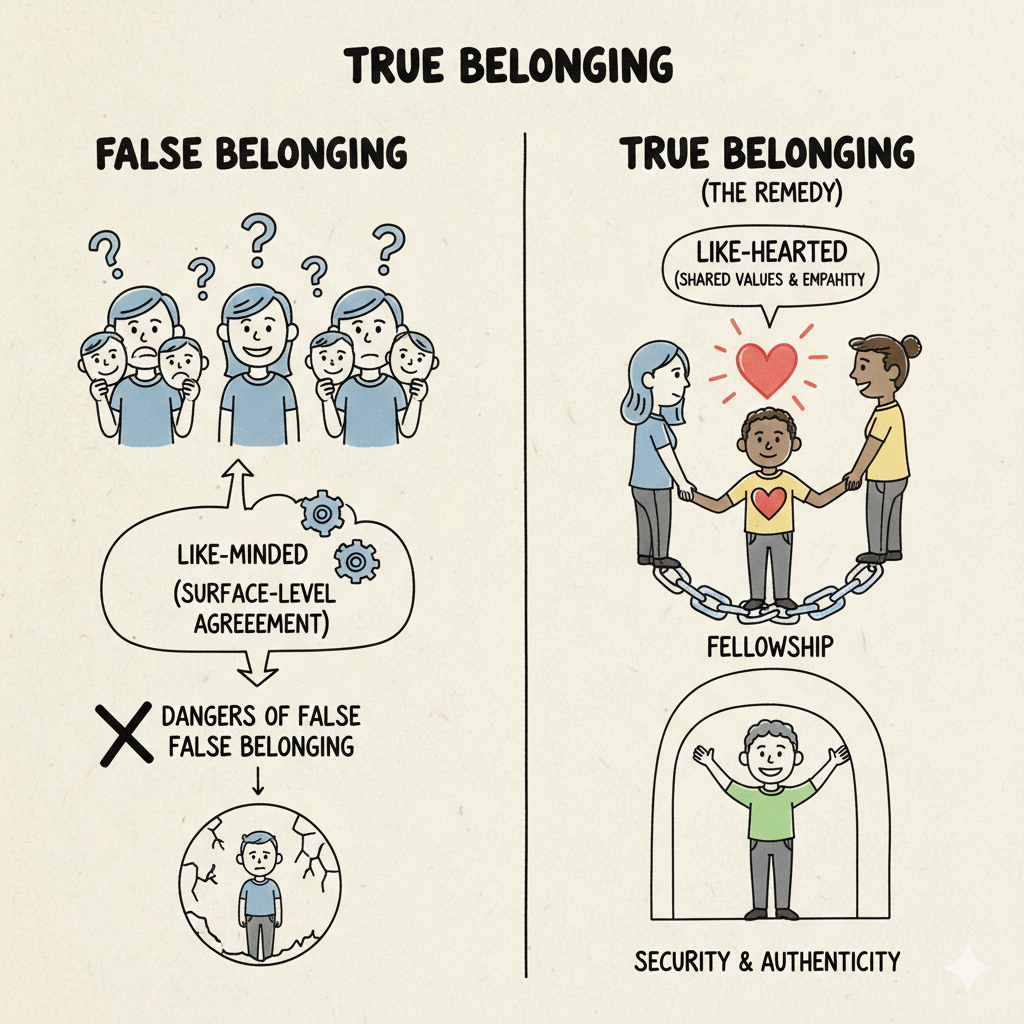
“The genuine community is open to thinking and questioning, so long as those thoughts and questions come from people of goodwill.”
Thinking for Oneself
The idea of thinking “for yourself” is more complicated than it sounds. Jacobs argues it is largely a myth — and that even the praise we give it is really just approval-signalling in disguise.
“Everything you think is a response to what someone else has thought and said. And when people commend someone for ‘thinking for herself’ they usually mean ‘ceasing to sound like people I dislike and starting to sound more like people I approve of.'”
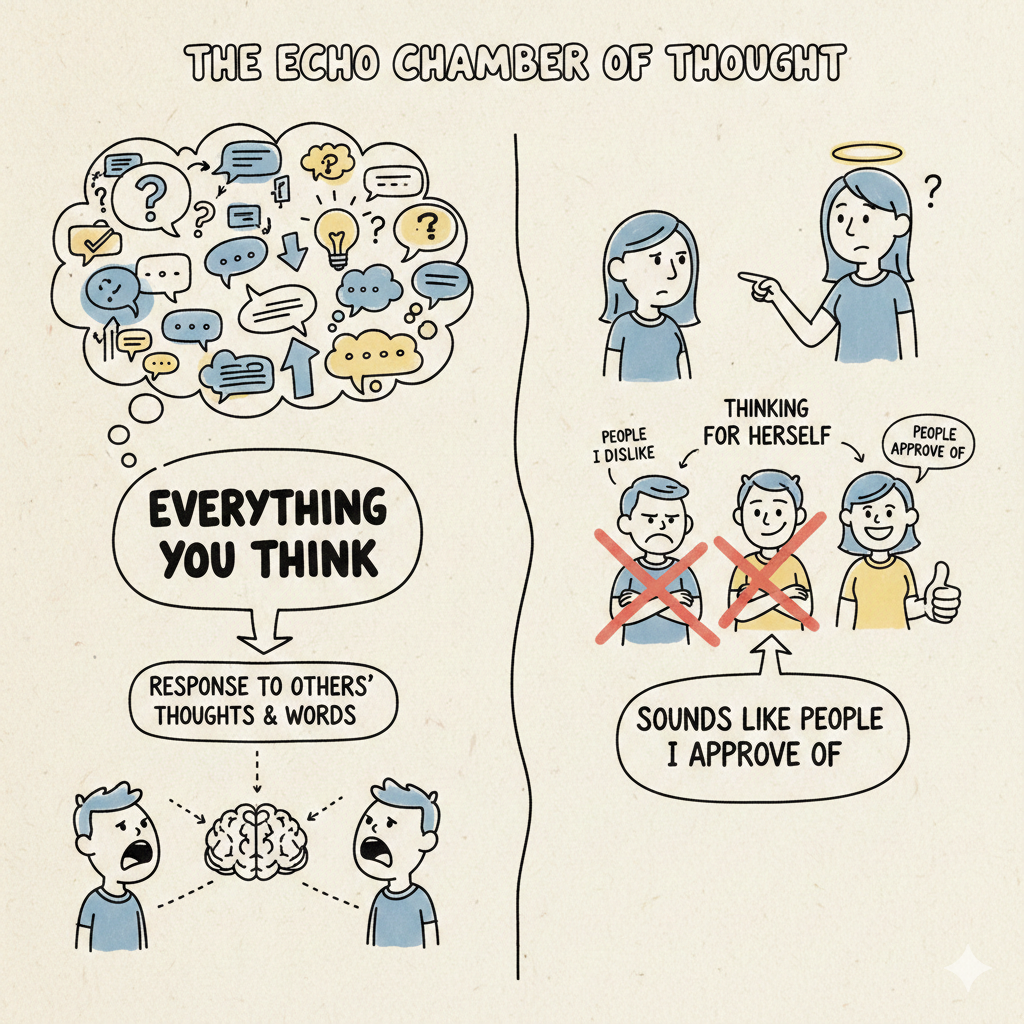
“How often do we say ‘she really thinks for herself’ when someone rejects views that we hold? No: when someone departs from what we believe to be the True Path our tendency is to look for bad influences.”
“Whatever we think we know, whether we’re right or wrong, arises from our interactions with other human beings. Thinking independently, solitarily, ‘for ourselves,’ is not an option.”
The Moon Illusion
Feeling vs. Analysis
Pure analysis, stripped of feeling, doesn’t make us more rational — it makes us less capable of good decisions. Reason alone turns out to be an insufficient guide to action.
“The habit of analysis has a tendency to wear away the feelings… when no other mental habit is cultivated, and the analysing spirit remains without its natural complements and correctives.”
“The imaginative emotion which an idea, when vividly conceived, excites in us, is not an illusion but a fact, as real as any of the other qualities of objects.”
“Damasio discovered that when people have limited or nonexistent emotional responses to situations, their decision making is seriously compromised. They use reason alone — and, it turns out, reason alone is an insufficient guide to action.”
In-Other-Wordsing
One of the book’s sharpest concepts: the habit of restating someone’s argument in your own words — not to understand it better, but to make it look worse than it is.
“Someone points at an argument and someone else replies, ‘In other words, you’re saying…’ And inevitably the argument, when put in other words, is revealed to be vacuous or wicked.”
“Straw-manning is a version of in-other-wordsing. But it’s also possible to in-other-words someone’s argument not to make it seem simplistic but to indicate that she holds views belonging to your adversary, to your outgroup.”
“We use these heuristics, these strategies of simplification, all the time; we just don’t like them used on us. We don’t want our lives summarized with an acronym, or our deaths with a bitterly ironic joke.”
Lumpers, Splitters & Social Taxonomies
The categories we use to sort people are useful — until we forget they’re categories and start treating them as solid walls. The lumper/splitter distinction is one of the most practically useful ideas in the book.
“The ones who like to put organisms in existing categories he called ‘lumpers’; the ones who like to create new categories he called ‘splitters.'”
“Our social taxonomies are useful, but if we employ them to enforce strict separation between one person and another, if we treat them as solid and impermeable barriers that make mutual understanding impossible, they serve us poorly.”
“The key to playing a really nasty character is to realize that in different circumstances you could be that person.”
“We need to accept that while knowledge may be analog, decision making is often digital — that is, binary.”
Keywords, Metaphors & Myths
In search of belonging, we stop thinking in arguments and start thinking in symbols. Keywords become shortcuts, shortcuts become myths, and myths do our thinking for us — invisibly.
“In search of social belonging, and the blessed shortcuts that we can take when we’re in the presence of like-minded people, we come to rely on keywords, and then metaphors, and then myths — and at every stage habits become more deeply ingrained in us, habits that inhibit our ability to think.”
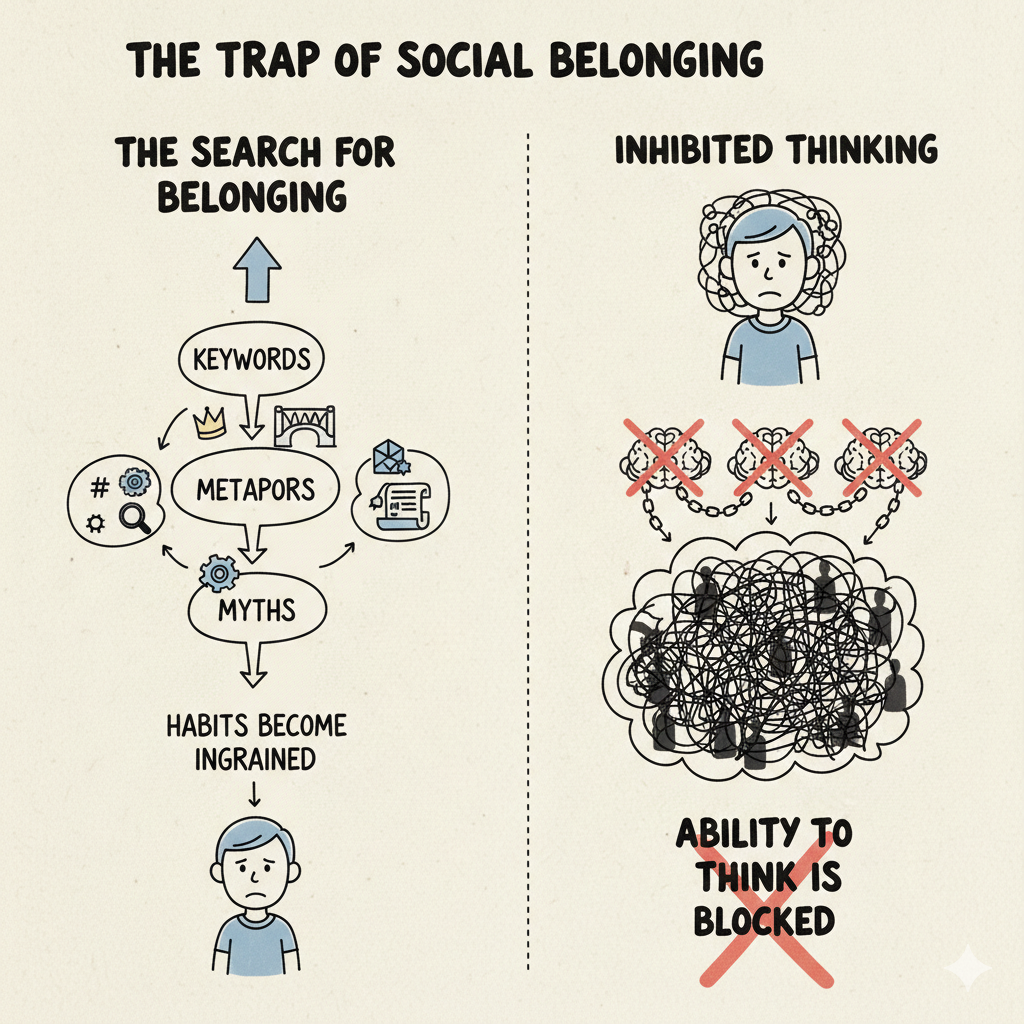
“People bind themselves into political teams that share moral narratives. Once they accept a particular narrative, they become blind to alternative moral worlds. Moral matrices bind people together and blind them to the coherence, or even existence, of other matrices.”
“Technologies of communication that allow us to overcome the distances of space also allow us to neglect the common humanity we share with the people we now find inhabiting our world.”
“You can know whether your social environment is healthy for thinking by its attitude toward ideas from the outgroup. If you quote some unapproved figure and someone turns up his nose and says, ‘I can’t believe you’re reading that crap’ — generally, not a good sign.”
“By reading, a man already having some wisdom can gain far more; but it is equally true that reading can make a man already inclined toward foolishness far, far more foolish.”
A Checklist for Better Thinking
Jacobs ends the book not with grand conclusions but a practical checklist — modest, honest, and harder to follow than it looks.
- When faced with provocation, give it five minutes. Take a walk, chop some vegetables. Get your body involved — your body knows the rhythms to live by.
- Value learning over debating. Don’t “talk for victory.”
- Online and off, avoid the people who fan flames.
- Remember that you don’t have to respond to what everyone else is responding to in order to signal your virtue and right-mindedness.
- If you do have to respond to signal your virtue or lose your status — you should realise that it’s not a community but rather an Inner Ring.
- Gravitate toward people who value genuine community and can handle disagreement with equanimity.
- Seek out the best and fairest-minded of people whose views you disagree with. Listen to them for a time without responding.
- Patiently, and as honestly as you can, assess your repugnances. Sometimes the “ick factor” is telling; sometimes it’s a distraction from what matters.
- Beware of metaphors and myths that do too much heavy cognitive lifting. Look for hidden metaphors and beware the power of myth.
- Try to describe others’ positions in the language that they use, without indulging in in-other-wordsing.
- Be brave.


About The Author

